 top.jpg)

© SkyCool Pty Ltd 1998 - 2015 - Patented in Australia, U.S.A. & other countries
Phone: +61 2 9477 4095 Email: info@skycool.com.au


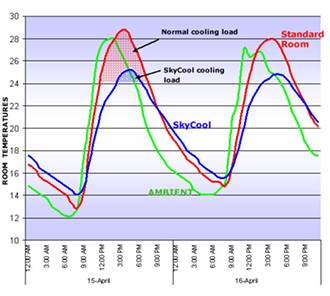
The chart, taken from a typical two days of the trial showing hourly room temperatures (compared to external ambient), illustrates the very much reduced cooling energy energy required under a SkyCool roof - blue shaded area compared to the normal red area.
A field trial was conducted in conjunction with The Department of School Education between December 2000 and April 2001 to evaluate the performance SkyCool in a demountable classroom environment at the Berkeley Vale Public School.
Portable classrooms are use throughout the State and have a reputation for overheating in summer creating a very arduous environment for concentrated education.
The demountable class rooms present a "worst case scenario" in which to trial SkyCool for the following reasons:-
-
Unlike supermarkets or warehouses, much more of the solar energy enters the occupied space through the walls than the roof.
-
Sub-roof insulation tends to trap in any heat entering the structure through windows and walls (as well as internally generated heat), keeping it away from SkyCool's ability to radiate it into space,
-
Open windows and ceiling fans permit a high rate of external air exchange bringing in the hotter outside air which SkyCool has to constantly re-cool.

Key Findings from this trial:-
-
SkyCool was significantly more effective at maintaining lower internal temperatures than any previously tested heat-repelling or insulating coating.
-
Although there were many environmental factors beyond the control of the trial including cloudy weather, use of the air conditioning unit in one room, air-exchange factors and room population, SkyCool produced excellent results over the whole period.
-
SkyCool was shown to be one of the cleanest and easiest coatings to apply. There was no need to evacuate the region or even the room. The liquid coating is water based and contains no toxic components. With exterior spray painting it is usual to experience a 20-30% loss of material due to wind drift of the spray mist. The total spray loss factor with SkyCool was 1.4% - it didn't even touch the boots of the applicators. Environmental and personnel safety are very important factors in the formulation of SkyCool.
Donvale Christian College